CEM SOLMAZ
IT PROFESSIONAL
In recent years, Artificial Intelligence has become the topic of conversation at every event, every meeting, and even in social settings. AI has ceased to be merely a talking point or a phenomenon that causes anxiety about the future; it has started to directly impact our lives. This process accelerated significantly with the bar-raising success of OpenAI’s ChatGPT bot in 2023.
AI has made certain tasks much easier; most of us now ask AI instead of asking Google. It has made incredible contributions to our lives with quick results in many areas, such as writing a blog post, creating an image, asking a question that pops into our minds, or learning how to use a newly purchased product.
To make a self-critique: I wrote my post-2023 blog articles with ChatGPT support (and I deeply regret this). Of course, this situation had some consequences. For instance, we now even answer emails with AI support. Blog posts and LinkedIn updates all seem to come from the same “cookie-cutter” mold. We are slowly realizing that these are no longer being read and do not add value to the reader. Furthermore, this comfort has made individuals think less; we are constantly borrowing ready-made ideas.
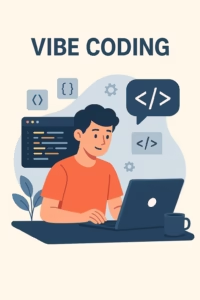
One of the processes affected by AI is the software development process. Previously, code was written line by line by hand; it would be deployed after long periods of analysis, coding, unit tests, and acceptance tests. Now, with what is called “Vibe Coding“—coding written specifically by AI bots—these processes seem shorter and more efficient at first glance. However, I believe there is room for improvement in concepts such as code quality, compatibility with existing code, and code continuity.
When I spoke with some senior developers, they used the following expression for code that used to take 10 days to write and verify: “We code it in 1 day now, but we spend 9 days debugging it.” While this looks like efficient work at first glance, it poses a risk for additional developments to be made in the long run.
Looking at it from another perspective; with the help of Vibe Coding, even a person who does not know how to code can write a mobile app or program by entering the right “prompt.” Of course, to deploy this program/application, one still needs to master system architectures. Nevertheless, I believe this situation hinders developers from seeing the respect they deserve. Because a code generated by AI—regardless of its quality—devalues the developers’ work and makes the process look “easy” to an outsider.
Recently, special AI tools that develop code from Functional Specification documents have also emerged. There are even products developed that perform dynamic coding via prompts and can quickly RFC this to relevant applications. There are even products that perform manual GUI operations via prompts. In my opinion, this situation can be considered a transition period for “No Interface.”
In summary, Vibe Coding is one of the new software development methods. It is possible to obtain software containing the desired functions with the right prompt, but this is a process requiring many iterations and must be supported by architectural knowledge.
Looking at the future, it is not difficult to foresee that the structure of teams will change. In the long run, instead of crowded teams with many junior developers, we may transform into more compact teams containing only 1-2 senior/medior software developers who “manage” the code and design the architecture rather than just writing it.